EU 230 V

Integrated system

EU 230 V.

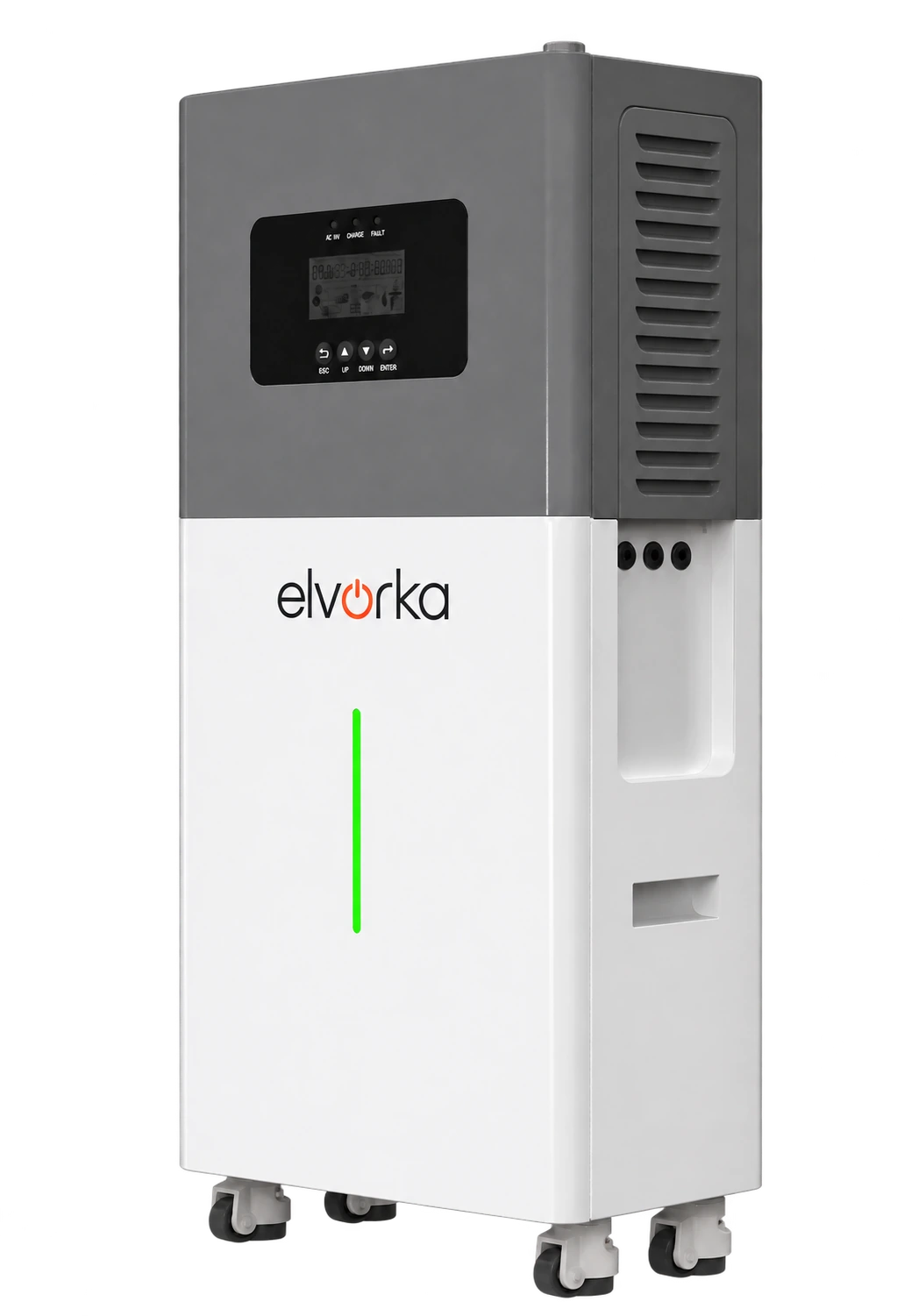
An integrated inverter and 51.2 V LFP battery system. Three listed power-and-capacity configurations, with rated AC output of 6.2 or 12 kW.

INVERTER
Included
ENCLOSURE
IP21
NOMINAL ENERGY
10.24 / 16.076 kWh
AC CONFIGURATION
230 V AC / 50 or 60 Hz
Start your project ↗

Specifications

Model / configurationEnergy (kWh)Rated AC (kW)
6.2K-10/16KWH-EU10.246.2
6.2K-10/16KWH-EU16.0766.2
12K-16KWH-EU16.07612

6.2 kW AC configurations: 1 MPPT and max. PV 6.5 kW. 12 kW AC: 2 MPPT and max. PV 2 × 9 kW. Wi-Fi, parallel operation and CT options require confirmation.

ModelDimensions (mm)Approx. kg
6.2K-10/16KWH-EU552 × 254 × 1210 / L × W × H105
6.2K-10/16KWH-EU552 × 254 × 1210 / L × W × H130
12K-16KWH-EU552 × 254 × 1210 / L × W × H130

Communication: USB / RS485 / dry contact
Temperature: Charge 0 to 55 °C; discharge −20 to 55 °C

Different climates. A specific place for your battery.

Australia spans tropical, subtropical and temperate climates. A warm northern equipment room, a summer-heated garage and a cooler southern or elevated location need different checks at the actual battery position.

Temperature:
Charge 0 to 55 °C; discharge −20 to 55 °C
ENCLOSURE
IP21
01

Summer heat · garage or dedicated utility room

Building materials, roof heat and afternoon sun can change the conditions inside a garage even when the outdoor forecast appears acceptable.

Record the hottest expected temperature at the unit and retain the selected manual's cooling and service space. TR Pro lists charging 0 to 55 °C; that upper boundary is not a full-power guarantee. Confirm HP Ultra temperature limits and any output derating for the selected configuration.

Does the room trap afternoon or roof heat?
  • What temperature and output derating apply to this exact configuration?
  • Can cooling and service space remain clear after installation?
02

Tropical north · humidity and actual exposure

The Bureau of Meteorology describes the tropical north, including Cairns and Darwin, as generally warm and humid, with wet and dry seasons. The indoor location still needs its own exposure assessment.

Choose a dry, protected location assessed for condensation, water entry and coastal exposure. EU all-in-one is IP21; TR Pro and HP Ultra list IP66. An IP rating alone does not establish suitability for condensation, floodwater or salt-laden air.

Is the room dry through the wet season?
  • Can water, condensation or coastal salt reach the equipment?
  • Does the exact model's placement guidance cover the proposed environment?
03

Cooler winter location · southern or elevated home

Temperate locations such as Melbourne and Hobart have distinct seasons. Check an unheated garage or outbuilding independently from the temperature in the occupied home.

If the battery position can fall below 0 °C, confirm the exact charging protection and any selected heating option. TR Pro lists charging 0 to 55 °C and discharging −20 to 60 °C; its optional self-heating must be confirmed. HP Ultra limits need configuration-specific confirmation.

Can the battery position fall below 0 °C while charging?
  • Is heating included and confirmed for this exact model?
  • Does the equipment room stay dry during cold-to-warm changes?

Specifications
  • Choose the architecture first: EU and TA6000 include an inverter. Battery-only TR, HP and TB families require a compatible external inverter with confirmed voltage, current and communication settings.
  • Check charging and discharging limits separately. Optional heating and a general operating-temperature field do not establish universal subzero charging; a maximum temperature does not promise full output at that temperature.
  • Use the exact enclosure rating and placement instructions. IP21, IP20, optional IP54 and IP66 are different source ratings; none alone establishes resistance to condensation, flooding or coastal salt spray.

PRODUCT DETAIL / ORIGINAL LITERATURE

Every side. Every connection.

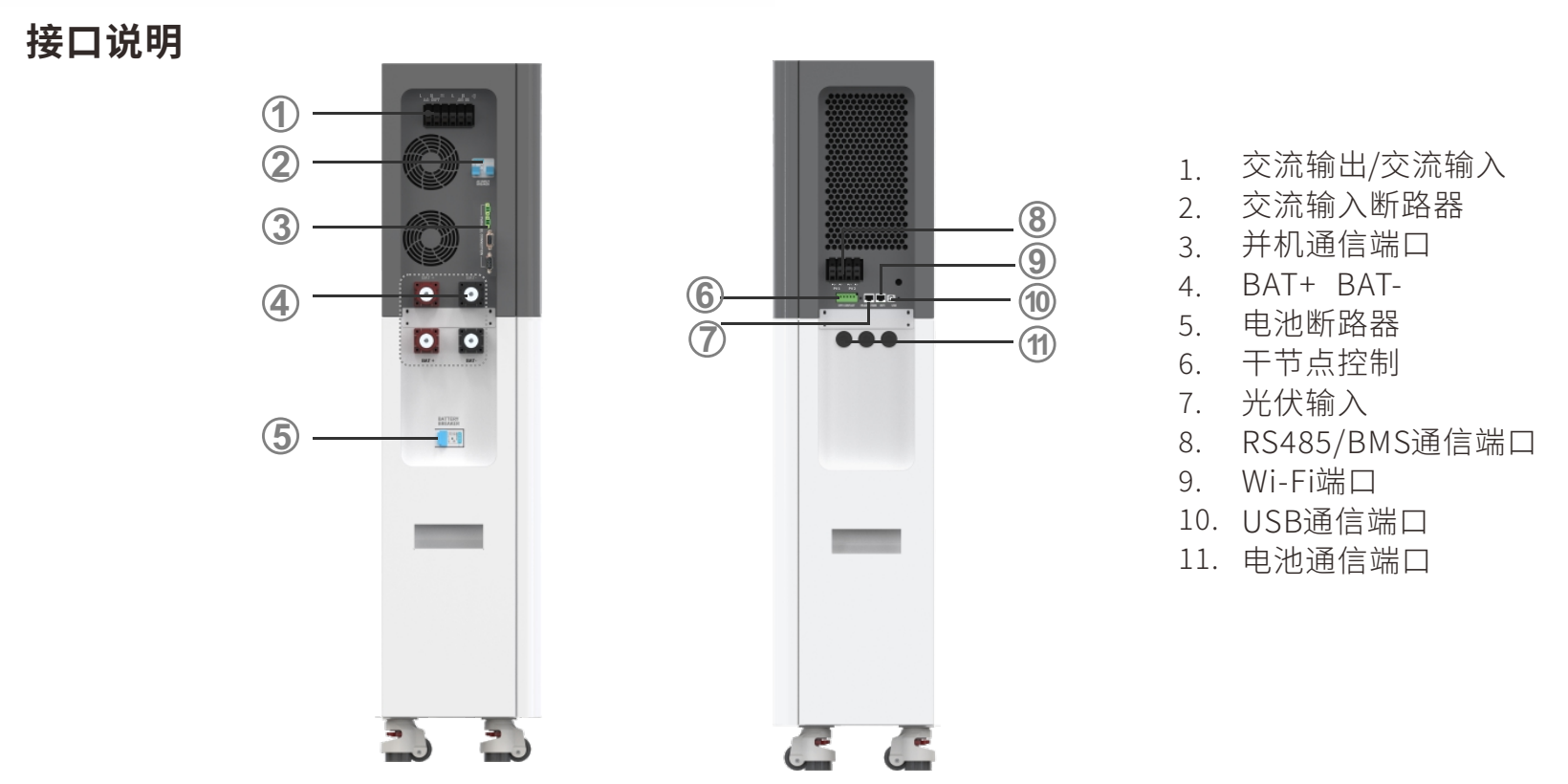
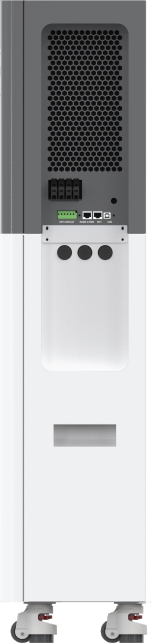
Views and numbering come only from the supplied one-page EU brochure. The source does not provide pinouts, cable sizing, wiring procedures or a complete set of every exterior face. Native side-image resolution is modest. A rendered map improves the original vector labels, not the native photographic detail.

Original numbered interface map
Original numbered interface mapNumbered map of the AC, battery, PV and communication connections.
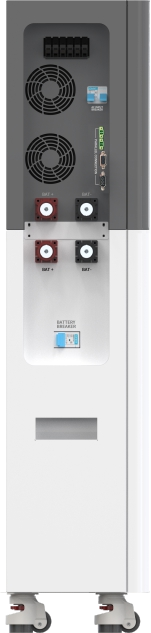
AC and battery connection side
AC and battery connection sideAC and battery connection side with cooling fans and the battery breaker.
AC and battery upper detail
AC and battery upper detailUpper AC connection area, cooling fans and BAT terminals.
PV and communication side
PV and communication sidePV and communication side, including the battery communication ports.
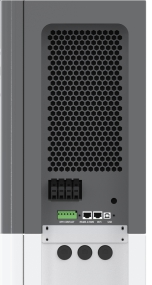
PV and communication upper detail
PV and communication upper detailVentilation grille above the PV and communication connection area.

Know your interfaces.

Power connections

AC input / output
The AC connection identified by number 1 in the original map.
AC input breaker
Breaker labelled for the AC input.
BAT+ / BAT-
Positive and negative battery terminals, as labelled in the source.
PV input
Input identified for the PV connection.

Communication

Parallel communication port
Communication connection labelled for parallel operation; configuration availability must be confirmed separately.
Dry contact control
Control interface labelled as dry contact in the brochure.
RS485 / BMS communication port
The communication connection named RS485/BMS in the original label.
Wi-Fi port
Port labelled Wi-Fi; the source specification lists Wi-Fi as an option requiring confirmation.
USB communication port
Communication interface labelled USB.
Battery communication ports
The source points to the group of three circular openings with label 11. It does not identify these as AC power inputs.

Controls & indicators

Battery breaker
Breaker identified for the battery section.

Source: EU 230 V product sheet · PDF page 1